Showing posts with label health talk. Show all posts
Wednesday, October 21, 2015

home made cultured ghee and health benefits of ghee | what Ayurveda and modern research say about ghee


benefits of ghee

Ghee is pure butter fat, also called as butter oil because it is made after clarifying butter. Ghee comes from milk fat (dairy) and can be of 2 types, one is uncultured ghee which is made by skimming all fat from whole milk and clarifying the fat directly to make ghee, but in most Indian homes you will find the cultured ghee.

Cultured ghee is made by skimming all the cream from whole milk, culturing the collected cream with yogurt culture (just like setting yogurt) and when the cream gets sour (cultured sour cream) it is whipped to separate the milk fat which is actually cultured butter. When this cultured butter is clarified by heating, it becomes cultured ghee with the most delicious aroma and taste..

benefits of ghee

We love our homemade ghee and would do anything to ensure we get good quality ghee if we can't make it at home. Mothers and grandmothers make ghee and collect to gift it to their kids who live away from them, to ensure they eat well and stay healthy. It has become a part of our culture to shower love by adding a spoonful of ghee in the curry or daal on the table. A pot of melted ghee on the dining table is a must have condiment or supplement during family dining.

It is notable that ghee is a good mix of saturated and unsaturated fatty acids and the smoking point is 485F (251C), it indicates ghee is the best suited fat for cooking at high temperature and it has stable saturated bonds.

It is not a surprise that this wisdom and culture around ghee goes back to Ayurveda. Ghee is considered cleansing, toning and nourishing for the system. There is a lot of modern evidence to support the truth behind the super food qualities of ghee.

Ghee contains Butyric acid, named so because it was first discovered in butter, Butyric acid helps maintain a healthy intestinal microbiome, it is actually secreted by many probiotic bacteria in the gut if the person has a healthy intestinal microbiome. This is one of the reasons why probiotic bacteria are considered essential for overall health. 

Butyric acid is also found in good amounts in butter and Parmesan cheese, it helps in irritable bowel syndrome (IBS) and helps in colorectal cancer.

Butyric acid is known to lower blood cholesterol as well as triglycerides, that indicates it is a potent anti inflammatory agent (read more here). Ghee (and butter too) is definitely a heart healthy fat. There is a reason why ghee and butter eating communities stay healthy.

It is difficult to find good sources of ghee now a days so making it at home is the next best thing.

benefits of ghee

The resultant ghee stays solid in Indian winters and starts melting as summer approaches, going through different stages of solid-liquid state, some globules of solid fat always found floating even in summers. Daanedar ghee (ghee with some solid fat globules) is a good test of pure ghee.

homemade ghee

How to make ghee at home...

There are 2-3 ways to make ghee at home. 

  1. You can buy cultured white butter from any organic source and melt it to clarify and make ghee. Strain the ghee to separate the solids before storage.
  2. You can buy heavy dairy cream, add yogurt culture to it and let it get sour by keeping it at room temperature for about 4-8 hours. Then churn or whip to separate the fat that makes the cultured butter. This cultured butter can be melted and clarified to make ghee.
  3. The third method is the way most of us Indian make our ghee. The whole milk is scalded and then cooled (in refrigerator). A layer of malai (clotted cream) gets formed when we rest the scalded milk overnight, this cream is collected and yogurt culture is added to it. One can collect the clotted cream for 3-4 days and then add the cultured yogurt so a good amount of butter can be made. The cultured sour cream is then churned to separate the butter which is then clarified. I am listing the detailed steps of this process.
The cream is cultured (which we call dahi jamana) till it gets slightly sour and smells wonderfully of rich yogurt. Then the yogurt is churned using a hand blender or in a food processor. Chilled water is added to the sour cream (malai ki dahi) to churn so the butter floats when separated.

Step 1 in the collage below shows how the white butter separates from the liquid buttermilk after the churning process. The true buttermilk comes from this process, we call this cultured buttermilk as mattha or kachhi lassi (lassi without fat). 

Step 2 shows the white butter which has been spooned out directly into a stainless steel pan (kadhai), some of the liquid buttermilk separated even after skimming the butter. It can be drained before clarifying the butter. 

Step 3 shows how the white cultured butter starts melting when we heat the pan. 

Step 4 we already see the butter getting clarified after heating. 


how to make ghee

This process of clarifying is very crucial for those who are lactose intolerant. The ghee should be cooked till all the solids get nicely browned and settle down. Stirring the mix a few times helps clump the brown solids together and settle down. You can see in the step 4 that there is a white layer on top of the bubbling ghee that is actually whey protein. The other protein called casein settles down from beginning and later when we cook the ghee further to clarify, even the whey protein settles down and browns. All this browned solid should be removed completely by straining if the ghee is being made for a lactose intolerant person. 

Rest of us can enjoy the brown solids by mixing it with sugar and nuts or any other delicious use. I often add it to my daals or rajma.

how to make ghee

The clarified butter gets a golden hue once cooked well. Straining it well and storing in either glass jars or stainless steel jars ensures the ghee stays good for long time.

The ghee starts getting solid after 2-3 days of making it.

how to make ghee

Most of the times I save some of the white butter to have it with our millet rotis and the buttermilk is enjoyed fresh. If the cultured cream gets too sour we use this buttermilk to make kadhi. Many families have a tradition to make kadhi whenever butter is churned and ghee is made.

benefits of ghee

Milk and milk products play a major art in our everyday food in India. Although now many people have started reporting being intolerant to milk, but they still can consume ghee safely.

Immense benefits of ghee suggest we must include it for our everyday meals. Those who don;t consume ghee everyday should try and maintain a healthy gut flora. Infact the countries where ghee is not a traditional cooking fat the populations depend on butter and probiotic foods to maintain healthy gut. Butter has most of the benefits that ghee has but contains lactose and other proteins that may cause health problems to 'some'. See how someone experienced that clarified butter is good for her lactose intolerant kid.

benefits of ghee

I asked Dr. Sangita Borgave from Pune about ghee and she enlightened with many more wonderful qualities of ghee as described in Ayurvedic texts.

Dr. Borgave says Ghee is a highly revered food article in Ayurveda which has many interesting properties. The most superior type of ghee is cow’s ghee but one can find descriptions of ghee made from the milk of many animals like , buffalo, sheep, camel, horse etc.

Qualities of ghee according to Ayurveda 

  1. Rasayana: This term means nourishing all the tissues in the body. In Ayurveda after detoxifying the body with Panchakarma, Rasayana  formulations are given to nourish all the tissues and cells in the body.
  2. Madhur: Ghee is sweet in taste. There are six types of taste in the body and Madhur or sweet is the first of these.
  3. Dipana: Ghee is one of the best natural digestives and appetite stimulants. The concept of Agni is very important in Ayurveda as this science believes that a weak Agni is the cause of all diseases. Ghee strengthens the Agni, improves digestion and appetite and therefore helps nutrients to reach the tissues.
  4. Chakshushya: Ghee is beneficial to the eyes. It strengthens the eyes and eyesight. It is used to treat various eye problems. ( SK: I remember my grandmother making kaajal using ghee).
  5. Sheeta: Despite increasing Agni, ghee is cooling in nature. Most herbs which improve the Agni and digestion are hot but ghee is an exception.
  6. Decreases Vata and Pitta: Of the three Doshas or elements in the body i.e. fire, wind and water, ghee helps control and decrease the former two. So those who suffer from excess body heat should always use ghee in their diet.
  7. Beneficial to the complexion/Enhances beauty: Consuming ghee regularly leads to a healthy glowing complexion.
  8. Ojaskara: Oja is an important but complicated concept in Ayurveda. Basically Oja is a substance found in very minute quantities in the body. It contains the best qualities of all the seven tissues of the body. Depletion of Oja leads to several mental and physical diseases and is difficult to treat. Ghee directly nourishes Oja and so should be a part of daily diet.
  9. Benefits the voice/speech: Ghee helps build a strong and clear voice. Ayurveda uses ghee to treat many speech disorders.
  10. Smritikar/Medhya: Improving memory/increasing intelligence.  Ghee is a very good natural  brain tonic. It should be eaten regularly by children, people in intellectual professions and old people.
  11. Aayushyakara: Ghee actually increases the life span. Many studies have clearly shown that consumption of healthy fats like ghee increase the life span, promote longevity.
  12. Strengthening: Helps in generalized weakness and general debility post illness.
  13. Vrushya: Improving fertility and libido. Ghee is said to be similar in consistency to Shukra or semen. So all Ayurvedic treatments of male infertility, and such problems will include ghee. Ghee also helps women conceive and have a healthy pregnancy and smooth delivery.


Medicated ghees are used to treat a vast number of diseases in Ayurveda but as one can see even simple, plain cow’s ghee is useful in innumerable number of ways. 

homemade ghee

Ghee should be a part of everyday meals as it has always been in our homes, else we will be forced to take it as a supplement. Yes ghee is so healing and nourishing it helps prevent many diseases if we take it everyday. 

Thankfully ghee suits everyone including the lactose intolerant if clarified well. Make some ghee yourself using either cultured heavy cream or home made cultured butter. 
   

Sunday, July 5, 2015

home made 'real' iced teas | basic recipe of Iced tea | staying away from synthetic flavoured iced teas

Iced teas are so easy to make at home that you would forget buying those hideous packets of crystalline sugar and tea concentrate. In the last one decade we have noticed that the flavoured soft drink concentrates have new competition by the flavored tea concentrates. Both these are loaded with sugar and artificial colours and flavours.

home made iced teas

Trust me even the Iced teas served in hotels and restaurants are all synthetically flavoured. How else they would serve Peach iced tea when peaches are not in season and Mango iced tea is the biggest sham. Please try and look into the ingredients whenever you order Iced teas at a restaurant, however swanky, ask if they can make ginger or fresh lime iced tea and order only after inquiring about the ingredients.

Having worked in a few commercial establishments I am an insider telling you how the costing issues makes them compromise on real flavours and how demands for fruits and produce 'not in season' pushes them to use synthetic flavours. In a way, indirectly we as consumers decide what we get on our table always. So if you order something in season, something available locally you get the real thing. If you want cheap blueberry iced tea you never get the real deal. I would assure you that I always insist on using real ingredients wherever I work as consultant and there are people who believe in real food.

herb infused iced teas

Ordering Iced teas carefully at restaurants is good, being aware helps and please know that any kind of Iced tea that comes in crystalline form in a plastic packet, ready to be dissolved with water cannot be real.

My question is, why we are even drinking them blindly when we can make our own real iced teas at home? India is a country where we take great efforts to make our milky chai and milky filter kapi (coffee) and serve these hot beverages proudly to all and sundry. Iced tea is way more easier than the milky chai and kaapi and we depend upon packets of iced tea? Not fair. 

To our advantage all Indian kitchens are well stocked with spices and green fresh herbs most of the times. Some of the spices and most of the herbs make great combinations with some read brewed green tea or any good tea that you like. My current favourite is Assam Golden tips from Mittal teas.

This peaches and basil seeds iced tea has been a favourite since long. Check out the recipe here..

peach and basil seeds iced tea

Basic recipe of Iced tea 

Take a large jug or kettle and tip in your favourite green tea or black tea leaves. Add some spice that you like, and a fresh herbs that you think you would like or some fresh fruit slices or a combination f all these to the kettle.

Heat water to 90-95 C, just when the water starts emitting bubbles, and pour it over the spices and herbs and loose tea in the jug or kettle. Cool down the tea while it brews. Refrigerate to get it as chilled as you want.

Some of the spice-herb-fruit combination you might like for Iced teas ...
  • Mint, lime and fresh turmeric shavings in green tea
  • Ginger, pepper and lime in green or black tea
  • Orange and star anise in green or black tea
  • Strawberries, lime and mint in green tea
  • Peaches, oranges and star anise in green tea
  • Oranges and cloves in green or black tea
  • Basil, lemongrass and pineapple in green tea
  • Hibiscus and clove or star anise in green tea
  • Roselle and Tulsi in green tea
  • Tulsi and ginger in green or black tea
  • Tulsi and honey in green tea
  • Lavender and lime and green tea
  • Matcha and Tulsi iced tea 
  • Kokum with green tea and honey 
Add ice cubes if you want or have the iced tea chilled to your liking. Some basil seeds in the Iced teas make then more attractive apart from adding some health benefits too.

Tulsi can be easily added to any tea when cold or warm, just bruit the leaves to infuse the flavours well. The Kokum and honey Iced tea with green tea brew is something that we often take with a hint of coconut milk too. Here in the picture it is just plain kokum brewed along with green tea and chilled, served with a drizzle of honey.

herb infused iced tea

When carrying iced tea for office you can keep them in the office refrigerator or just freeze the bottles overnight and carry them so they thaw and stay chilled after a few hours.

This Lavender and lime iced tea is so refreshing and exotic you would forget all fancy looking iced teas you order and carry this one to your long drives and even for office time beverages. 

lime and lavender iced tea

This Matcha cold brew with bruised fresh Tulsi leaves is another favourite with a drizzle of honey.

To make this match and tulsi iced tea, just make a slurry of matcha powder with cold water and pour over ice cubes, fill with chilled water and add some bruised fresh Tulsi leaves. Add honey to taste and enjoy as you wish.

Matcha and Tulsi Iced tea

And our current favourite at home is this Roselle and fresh Tulsi Iced tea with silver tip green tea, chilled in the fridge and not with ice cubes as it dilutes the flavours. This is one flavour you wont like diluting. Roselle is from an organic farm Aiyor Bai, run by a dear friend Madhu Reddy. Tulsi is growing abundantly in my own garden this season.

roselle and tulsi iced tea

You can always grow some herbs easily in your balcony or terrace garden and use the herbs for making iced teas. For an intense lime and tulsi iced tea I use my limes (nimbu) a lot. The iced tea below is made with a green tea brew with crushed lime leaves (nimbu ke patte), some crushed Tulsi leaves and fresh lime slices.

Another Lemongrass and Basil iced tea is made using a green tea brew, lemongrass infusion (made with boiling lemongrass leaves for 5 minutes) and freshly crushed sweet basil leaves.

iced teas

I have been posting ideas about lunch boxes for adults and when I posted the picture of bottles of iced tea, infused water and buttermilk last week on my facebook page, many of my friends and readers asked where do I get those bottles and what other containers will be suitable for carrying beverages. A few friends even called and told me they have started carrying buttermilk and iced tea to office after reading about them in the last post.

If not iced teas, you can just infuse drinking water with tulsi, basil, mint or limes or ginger, turmeric, fenugreek seeds etc. I know the websites and blogs are full of attractive pictures of fruit or cucumber infused detox water but you must know this is just a fad. The fruit infused water just makes the drinking water more desirable, so you drink some more water and that is definitely cleansing. But if you want health benefits from this water it is better to infuse the drinking water with herbs that your body needs. 

infused water and iced tea

Simple common sense things that work wonders for changing habits. If you have been ordering Iced teas or soft drinks from your office canteen please get some bottles and start carrying your own real beverages. I am putting up a couple of these bottles as a lucky give away for the lunch box series too.

Share your ideas about lunch boxes in general, or iced teas that you would like to carry to your office in the comment section below and get a chance to win two of these bottles. 

But brew some good tea, have it hot, warm, chilled or iced and relax. A good tea is a thing to cherish. 

Monday, January 26, 2015

olive oil revolution | is olive oil suitable for Indian cooking? | which grade of olive oil is best?


I get a lot of queries about usage of olive oil for Indian kitchens. There are so many brands available and so many variants of olive oil that one gets confused about which one is right for cooking what? And if it is worth the money even if one takes the plunge. I know many people who actually cook all their meals in olive oil exclusively (*olive pomace oil actually) now and many more who have been planning to move to olive oils for everyday cooking but the cost is the inhibitory factor.


Else all the TV commercials are here to announce that you can fry your jalebis and pooris in pomace and that it is still healthy. How much more contorted it could get.

The goodness of cooking oils is only measured on the scale of how much high temperature it can withstand because all Indian homes deep fry all their food everyday. Right?

I say wrong. We don't deep fry all our foods and we do need other qualities in a cooking oil too. A cooking oil should be rich in omg3 and NOT have a higher omg6 ratio to omg3 as it becomes inflammatory in nature. But that is not the concern with olive oil because it has all the goodness of omega 3s and good amount of polyphenols if it is good quality.


Good quality olive oil is a genuine concern in our country because olive oil is labeled WRONGLY here. While extra virgin olive oil (EVOO) is great if the brand is good and trusted but there is no virgin olive oil. All the oils labeled as 'virgin olive oils' are a mix of extra virgin olive oil and 'refined olive oil' and that is an absolute sham.

Normally virgin or pure olive oil should be olive oil that is not cold pressed but thermal process has been used to extract oil but that is not as bad. The oil still has it's goodness. Read the label carefully before buying this category of oil and see whether 'refined olive oil' is added to it.

Now one needs to know what is 'refined olive oil'. Refined olive oil is nothing but *olive pomace oil and we need to read the label carefully to ensure before buying. Olive pomace is the oil cake leftover after the cold pressing process and the olive pomace oil cannot be called as olive oil as per law of many countries that produce olive oil. The process of extracting oil from pomace involves the use of chemical solvents and the resultant oil is industrial quality fit only to be used as a lubricant or saponifying agent at the most. Marketing olive pomace oil as a healthy product in India is WRONG and is misleading people. Jalebi fried in pomace oil CANNOT BE HEALTHY.

I attended a masterclass with Chef Kunal Kapoor recently at Le Meridien hotel where he cooked a few recipes with Olive oil and a nutritionist Dr. Seema Singh spoke about the health benefits of it. As I mentioned, cooking with even extra virgin olive oil is okay if one is cooking a pasta sauce or is quickly stir frying vegetables as the temperature in the pan doesn't go beyond 110 C in that case. Chef cooked a chicken kabab with avocado in olive oil and made everyone taste it too. A pineapple chutney was also cooked and served to all.


Extra virgin olive oil is great as a source of antioxidants and omega3s but we must include many more types of antioxidants and omega3s in our diet so we are not dependent on oils for them. We must remember that cold pressed mustard oil is as healthy as cold pressed extra virgin olive oil if we use it sensibly. Remember not to smoke any oil during cooking.

Using only olive oils is no guarantee that you will lower your cholesterol level if you have switched to it for this reason. If you keep eating refined foods, refined ingredients (like white flour, white sugar, HFCS or corn syrup) and less fresh produce you may get prone to high levels of inflammation, metabolic disorders, high cholesterol and related symptoms. Fixing the lifestyle is the solution, none of the healthy ingredients can fix it in isolation.

I love using extra virgin olive oils myself a lot and many of my salads and ALL pasta dishes use EVOO freely. But I would never switch to EVOO for my Indian food.I cook my north Indian food in mustard oil or ghee, south Indian in sesame and coconut oil, pakodas are fried in mustard oil, poori and parathas are fried in ghee.

I would be really glad if Olives are grown in India and we get access to good quality cold pressed EVOO closer home and can enjoy the best flavours in Mediterranian and Italian foods that we love. Till then I would look for my EVOO and would not bother about pure virgin olive oil even if comes without a mix of refined olive pomace oil.

To supplement my food I have my extra virgin cold pressed mustard oil and extra virgin cold processed sesame and coconut oil along with ghee and butter to use every day. It is not saturated fats that increase cholesterol in the blood, it is high degree of inflammation caused by processed foods and faulty lifestyle that leads to increased levels of cholesterol.

To manage cholesterol one needs to minimise inflammatory load on the system. The best way to do so is to live an active life, exercise regularly, switch to cold pressed natural oils (not refined processed oils and margarine) and ghee, use them judiciousely (not fry everyday food) include more and more fresh produce, fruits, seasonal greens and vegetables in everyday diet.

Monday, November 3, 2014

how to use beetroots to make tasty salads? | two salad recipes with beetroots


Beetroot salads are a great way to include this antioxidant pigment rich root vegetable in everyday meals. One can always make smoothies with beetroot or can add it to curries or raitas but a simple salad is more suitable for a meal when you are alone or when you need a good looking salad for an elaborate meal served to family and friends. I have seen huge bowls of salads disappearing in minutes when served to friends or when the both of us make such salads for weekend lunch. So whoever says salads are boring, has never had a good salad I say.The beetroot salads I am sharing today have all the potential to become family favourites as we have had these salads numerous times and even after refrigerating them for a day or two. Even the roasted or boiled beetroots stay well in the fridge if drizzled with some balsamic vinegar or any vinegar of choice. Without vinegar the cooked beets stay well for 4-5 days easily. Keeping them ready to use is a great help when considering beets are so messy to chop and shred.

Top reasons why you should include beetroots in your diet everyday...
  • Beetroots lower blood pressure owing to the presence of Nitrates in them which converts to Nitric oxide in the body and dilates and relaxes the blood vessels.
  • Beetroot consumption is known to enhance stamina by the action of Nitrates as well as betaines found in them.
  • Betaines help fight inflammation in the body too, good for heart health and overall fitness and performance.
  • The pigment profile of beetroots makes it a good anti-carcinogenic, the anti-oxidant property helps the body take care of ageing and wear and tear.
  • Beets are rich in essential minerals, fiber and immune boosting Vit C, and B Vit folate, great for healthy skeletal system and internal organs.
  • Beetroot helps cleanse the system and make the liver and GI tract healthier.


How to make salads more balanced nutritionally...

  • A great salad would always include ingredients that pair well taste wise and their nutrient profile is complementary. All the ingredients should contribute nutrients in a way that it helps better absorption into the system. 
  • Like if one ingredients is iron and calcium rich, there should be some other ingredient that is rich in Vit C as the minerals wont be absorbed in the absence of Vit C. 
  • Likewise if there are antioxidant pigments of the carotene family thee should be some fat (oil) dressing in the salad or in the same meal, as all such antioxidants and Vitamins are fat soluble and would be wasted if you did not add any oil or natural fat like Avocados or coconut.  
  • Adding nuts or cheeses to such salads makes sense in adding protein as well as good fats to improve the nutrient profile of the salads.
  • Adding cooked chicken breast or fish or bacon is a good idea to bring more proteins and healthy fats into the salads. Add moe greens like lettuce, rocket or baby spinach or micro greens in such salads to make them tastier and Vitamin rich.
  • Lime juice and tamarind extract are great for the acidic ph that helps absorption of many minerals. Yogurt or buttermilk dressing also serve the same purpose while vinaigrette is more common in salads.


I must add if you find the salads insipid with the available ingredients, just whiz everything up and make a smoothie. Like this beets, black grapes, amla and ginger smoothie is yummy and nutritionally balanced as well.


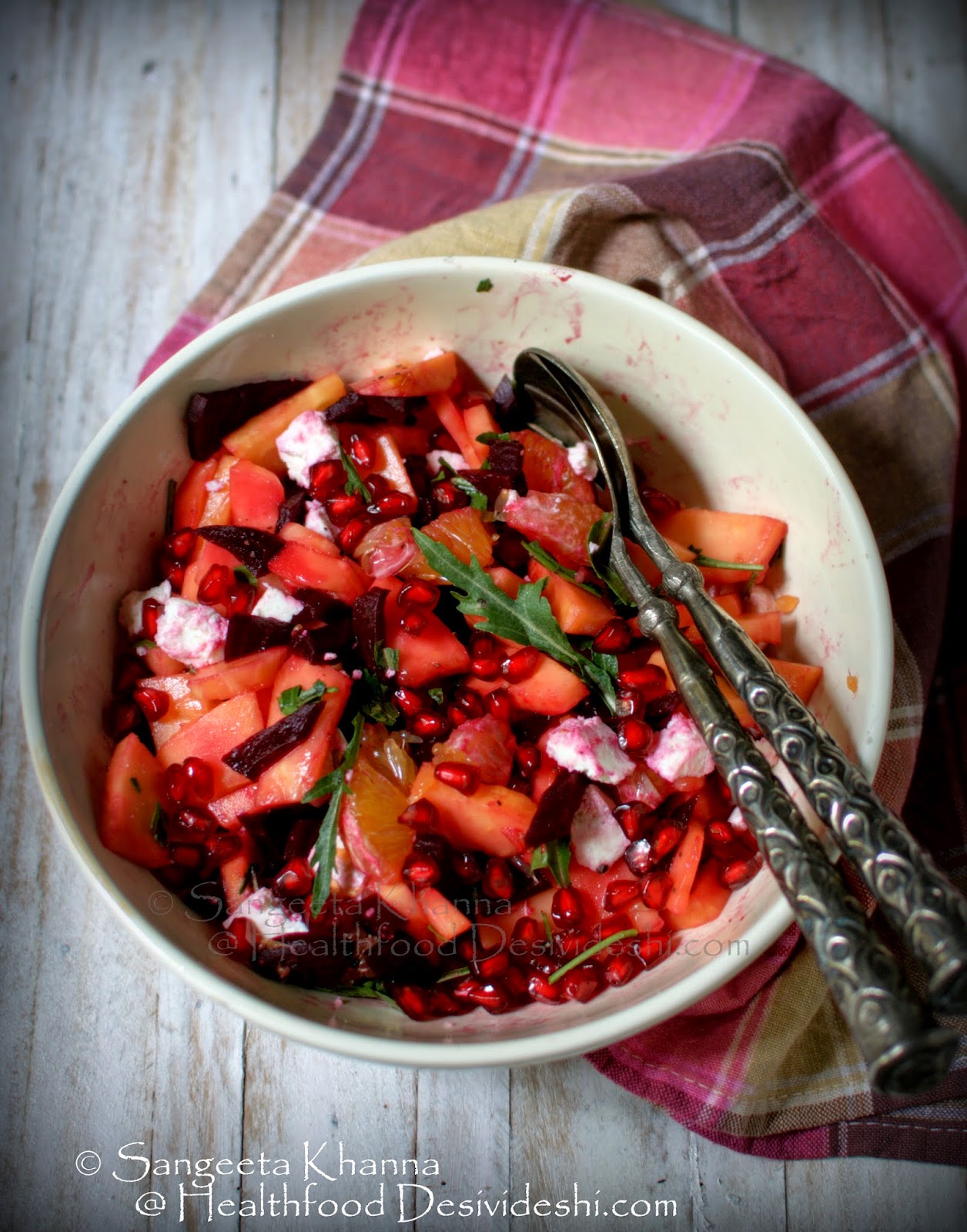
recipe of beetroot papaya salad with feta cheese...

I tried this recipe once when the papaya I had bought turned out to be very insipid in taste. I found the balsamic pickled beets added the much needed flavour to the papaya and pomegranate seeds brought the much needed texture. I Used some home made feta cheese and rocket leaves from the garden and this salad was an instant hit. The salad has been a frequent weekend lunch for us since then.


ingredients
(2 large meal servings or 4-6 as a salad on the side in an elaborate meal)

cubed papaya 2 cups
**pickled beets 3/4 cup or a bit more
pomegranate seeds 3/4 cup
cubed feta cheese 1/2 cup (replace with 3 tbsp chopped roasted almonds or walnuts of you don't get feta cheese)
orange segments 1/2 cup
kala namak (black salt) 1/4 tsp
table salt 1/4 tsp or less
ginger juice 1 tbsp
rucola, arugula or baby spinach a handful (or just use mint leaves)

**To make pickled beets I just cook the beets in microwave, chop them in small slices and douse them with a little salt and a generous pouring of balsamic vinegar. It keeps well in the fridge for a month or more. I use the pickled beets for many salads or just as it is.

procedure..

Just toss everything together and mix well. Add the pickling liquid of the beets as well. Serve after 10 minutes so the flavours get some time to mingle. This salad stays well for a day or two in the fridge, but everything will look deep pink after a while. 


recipe of beets, pumpkin and sweet potato salad with a south India tadka dressing..


I used pan grilled pumpkin and sweet potatoes along with microwave cooked beetroot slices for this salad. Once the cooking of the vegetables has been done the salad can be put together in seconds. 

ingredients

(for 2 servings)
2 thinly sliced pumpkin wedges (300 gm)
2 small thin sweet potatoes (100-120 gm)
one large beetroot (120-150 gm)
hung curd (full fat or 3%) 1/2 cup (about a cup of fresh yogurt used)

for tempering dressing..
curry leaves 3 springs
urad daal (split and skinned black beans) 2 tsp
mustard seeds 1/2 tsp
asafoetida (hing) one pinch 
broken dry red chillies 2
sesame oil 2 tsp 

procedure

Pour the yogurt in a fine mesh strainer (or lined with muslin) and prop it over a bowl. Keep this hung curd contraption in fridge. It takes about 3 hours minimum to get hung curd but it stays well in the fridge for 2 days. Keep it ready to use.

Peel, cut into half and microwave the beets for 3 minutes. Chop in bite size pieces and cool down.

Clean the sweet potato, retain the skin but remove any blackened skin. Slit lengthwise and keep aside.
Clean the pumpkin slice, retain the skin and keep aside.
Heat a skillet, brush with butter or oil and arrange the pumpkin slices and sweet potato halves on it, sprinkle salt and cover to cook on medium heat. Turn and cook on the other side for 3-4 minutes or till both sides are lightly charred (browned) and the flesh is soft (but not mushy).
Remove from pan and chop in small bite size pieces. Cool.

Now mix the beets, pumpkin and sweet potato pieces. Now invert the hung curd over the vegetable mix. Now you can actually mix the yogurt with the vegetables but it will get pink immediately. So I keep the hung curd like this till we actually eat this salad. Looks good too.


Now is the time to make the tempering dressing. Heat the oil and tip in all the tempering ingredients. Let them get aromatic and then pour everything over the disc of hung curd.

Let it sit till the salad reaches the table. Mix it when you want to eat it. Mixing it on lightly the table is an exciting activity as I find people getting curious about it.


I was very skeptical about Arvind's choice as he wont eat pumpkin so easily in a salad. He loves his kaddu ki subzi but would think twice before picking up kaddu (pumpkin) is a salad. I didn't tell him when I made it for the first time. He could recognize only sweet potatoes and beets in this salad and when I told there is kaddu in it too, he exclaimed Oh Yess... and picked up another fat piece of kaddu :-)
 We are a salad couple now. There is a salad meal almost 3-4 times a week and we both love it. Although I keep making some quick salads for myself in the day time and eat them all alone too. Can't live without vegetables even though I eat so many other things too.

Hope you like these two different types of beetroot salads and try them in your own kitchen. Please do let me know if you like beetroots a bit more after trying these salads..

Cheers.


Wednesday, July 9, 2014

building up the health quotient everyday | being featured on cover story of Good Housekeeping India

All of us are aware about the basic science behind the healthy food and beverages, hydration and maintaining a good basal metabolic rate through food and exercise. It is unfortunate that the science and the knowledge do not translate into practice most of the times in everyday life. We are caught up with so many hassles every single day from traffic snarls to delayed deadlines, from absentee maid to a sick child that we often fall prey to the most convenient plate of food available when hungry or a strong sugared cup of tea or coffee when stressed. We often skip a much required workout when there is a time crunch and feel guilty later.

How do we make provisions to follow small little things to keep ourselves fit and healthy?
To bring a little discipline into our routine so that we can follow what we know is not that difficult. A little planning, stocking up the desired foods and beverages, keeping them in strategic places and setting alarms if required works really well. Here is what all I try doing and recommend everyone to try for a fortnight and see how it brings change in the attitude towards healthy living.

All these tips were shared in the cover story "Health on a Platter" in Good Housekeeping India (July Issue) and I am glad that Manjira Dutta, the Editorial Director complemented me personally to have made such an exhaustive and practical list for GHI readers. 


Here is the un-edited version I sent to them.The cover story included 7 recipes from me excluding the recipe of the cover picture, whole wheat apple muffins.

Brew a large kettle of green tea infused with fresh herbs and fill in a flask that sits on your work desk. Have it hot or iced as required in between meals, along with meals or after meals. This is a great way to stay refreshed throughout the day. Grow your own herbs in pots if possible and see how tending to them even for 5 minutes a day keeps you sane.


     Stock fruits, salad greens and vegetables weekly, get the portions for the whole day peeled and chopped in the morning and pack them all in convenient containers or ziplock bags to be placed with different meal times and snacks. This is a great way to not forget having your fruit or salad for the day.


      Smoothies are a great way to eat your fruits conveniently combined with soaked nuts. This way the smoothies make a meal and these can replace your breakfast. You can freeze the fruits and soak the nuts overnight and liquidize all of them in the morning for a fresh and filling breakfast.


     Invest in some cast iron pans and skillets and get your food cooked in them so you get more iron available to the system. See how cast iron pans help get more mineral into your system.


      Buy and consume only seasonal and mostly local fresh produce. Although most vegetables and fruits are available throughout the year these days, it is better to choose seasonal as the fruits and vegetables are packed with nutrients in their natural fruiting season. Buying local fruits and vegetables helps us get the freshest  produce that has not been treated with chemicals for longer shelf life, apart from reducing the carbon footprint.


      Include more and more colors in your food, all seasonal fruits and vegetables are nature’s way of telling us what we should eat in the season. The pigments in the plants are packed with antioxidants and minerals. Yellow papayas, oranges and tomatoes and carrots have Lycopene and Carotenoids, red amaranth leaves, beets and Swiss chard have Betalains, red cabbage, aubergines, black currants and grapes, cherries and plums, peaches, black berries and blueberries, cranberries etc have the pigment called Anthocyanins. These natural pigments help us incorporate a wider range of antioxidants along with Vitamin C in our daily diet.


      Fresh greens are essential in everyday diet. Be it leafy greens like spinach, fenugreek leaves or amaranth and purslane or herbs like coriander, mint and basil, all of these provide a wide range of minerals and vitamins. Fresh leafy greens feel like a lot of work but it can be managed well if one buys them weekly or fortnightly in bulk, gets them cleaned and chopped for the weeks to come. The chopped or steamed leafy greens and herbs can be packed in ziplock bags and frozen for 6 months or can be refrigerated for a week easily. Herbs keep well in paper bags for a week, if frozen they can last 6 months too. 


     Whole grains are not over rated. Look out for grains other than wheat and rice and include all of them for everyday meals, find more ways to bake breads and pancakes with them so you enjoy eating them. Dependence on one staple grain is not good, variety is the key for nourishment as well as taste. The grain portion should be small always, fill up your plate with greens and some protein for all meals.

        
     Eat grains in fermented form. Dosa, idli and sourdough breads are the best way to incorporate extra minerals and vitamins for the body. The yeast breaks down the nutrients found in the grains in most digestible form and supplements the batter or dough with more minerals and vitamins because of their own by products during fermentation.


    Allocate 3-4 water bottles of different colors for each family member and see to it that the water is consumed during the day. Everyone will slowly start noticing how less water they were drinking and will be tricked to drink more water. Add mint or lime slices to water bottles to make every sip enjoyable.
      Take care to include good protein source in every meal. Paneer, tofu, mature cheeses, nuts, seeds and beans are great for vegetarians and chicken and fish are great for non vegetarian everyday meals. Red meats and bacon etc can be had occasionally.


      Add flax seeds meal to your bread flour or chapatti flour so you get good quality fiber and some omega 3s in your meals regularly.


      Include yogurt and some fermented drink like carrot kanji or some fermented salads like sauerkraut in everyday meals. The probiotic bacteria found in them make the gut flora healthy and help better absorption of nutrients. Poha, puffed rice and fermented congee are other sources of healthy probiotic bacteria.

      Include more nuts and seeds in everyday diet. Omega 3s take care of the inflammations due to daily wear and tear in the body or due to stress.


      Be cautious when eating out. Strongly colored foods and MSG laden dishes should be avoided at any cost. Freshly cooked simpler foods are always better.
      Listen to some slow soothing music of your choice for at least 10 minutes every day and meditate while you are at it. You will be charged up for the next task of the day.
      Make a niche in your home or office with real green plants or herbs, include a tulsi plant too. Water them every day, pluck a few tulsi leaves and chew on them. It will refuel your spiritual energy, help you connect with yourself better.


      Last but not the least, get up from your work desk almost every hour, stretch your neck, shoulders and legs if possible, drink water or green tea, splash cold water on the eyes and blink several times to refresh the eyes. It helps you not get exhausted easily and enhances work efficiency apart from boosting your health.

 
Healthy Way powered by blogger.com
Design by Free7 Blogger Templates Simple Clean