Showing posts with label organic farming. Show all posts
Friday, February 26, 2016

National Permaculture Convergence by Aranya Agriculture Alternatives | my experiences as a speaker and as a participant


Few months ago I got a mail from Mr. Narsanna Koppula inviting me for speaking at the National Permaculture Convergence (NPC) his organization Aranya Agriculture Alternatives was hosting. I will be honest in admitting that I felt my presence in the whole scheme of things a bit misplaced initially.

NPC was going to be a convergence of hardcore activists and people who are working relentlessly in the field of organic ways of farming, wasteland reclamation and all the jazz associated with growing food ethically and sustainably, preserving germplasm and opposing GM crops for all the good reasons. I asked myself how would I be able to contribute to this cause. But people associated with NPC have been following this blog and my work elsewhere and they had better idea of what they wanted from me.


Mr. Narsanna himself trains people and organizations about Permaculture design and all the other eminent speakers would be talking about issues ranging from soil, waste management, pest management, water management to the principles of Permaculture design, Biodynamic farming and Food Forests. I was invited to speak about the correlation between soil quality, food and nutrition and native and uncultivated foods in 2 separate sessions. 

After a bit of hesitation when I gave it a thought I felt I could definitely add value in terms of talking about the end product of all the ethical farming practices. The food. The way food controls our lives and the ecology at large, the way we can make choices to nourish our own body and allow the ecosystem to support sustainable farming of food crops, the way food can come from uncultivated sources and how to make the best use of it. Human health translates to the health of the planet in many ways.
I am glad I went to this National Permaculture Convergence (NPC) and attended most sessions on all three days. I got to learn so much from other knowledgeable speakers, met many people and made great friends too. It was really awe inspiring to see people from all over the globe leaving a flourishing career to start farming in remote areas, people working on water management and energy management despite time and financial constraints. Over 50 speakers shared their expertise, number of total participants was 1180 of which 700 were farmers who came from rural Andhra Pradesh, Telangana and few other parts of the country. The event was managed by 100 plus very efficient volunteers who worked for 4 months to make this event a grand success. This is how it works when likeminded people work with all their passion.


The keynote address by Dr. Vandana Shiva was quite motivating; it was wonderful to hear her speak once again about her work and concerns. Among the sessions I attended, I loved the way Prof. Sultan Ismail demystified soil for everyone and explained why the ancient wisdom of keeping cows and livestock at the farms is a way to make farming self sustaining. He also emphasized the importance of microorganisms in living soil ecosystem where a symbiosis of several organisms helps the cause.

Clea Chandmal’s sessions on developing food forests and reclaiming the soil were quite educative and eye opening. She has done several experiments and has been successful in reclaiming soil and made it fit for agriculture. 


Rosie and Peter Harding spoke about how they revived a stretch of land in Goa and have created a thriving Food Forest that gives them loads of varied produce. 


Priya Ramasubban who is an acclaimed film maker has worked on resurrecting a lake in Bangalore despite several odds. She threw light on how the water bodies play an important role in urban landscape and what measures should be taken to revive them. 

Umesh Dutt from Kheti Virasat Mission spoke about how the farmers of Punjab are so detached with their own soil that they are ready to migrate to other countries any minute. He suggested solutions and his session was quite poetic and much applauded. The only session that was translated in 2 languages.

Uzramma spoke about the journey of cotton in India. She talked about how cotton was bred and genetically modified to suit the machinery after the Industrial revolution and how the GM cotton has destroyed farms and livelihoods. Her brand Malkha had a stall at the venue and I ended up buying a saree after over a decade. Hopefully I will do justice to the saree and wear it. 

Caitlin, Sukriti and Amol are co founders of the Academy for Earth Sustainability (AES) whose mission is to promote the transition to sustainable ways of living in India through collaborative, practical and hands on learning experience. They work a lot with schools and other local community organizations. Their session showcased the work and possibilities.


Vani Murthy and Uma Kandasarma work on solid waste management and conduct workshops on home composting and rooftop gardening. I missed their session and waiting for the recorded sessions to go live on youtube.

There were many other sessions by Rico zook, Bharat Mansata, Suresh Save from Kalpavriksha, Anjali and Kabir from Yarroway Farm, Claude Alvares, Ardhendu Shekhar Chatterji, Sajaya Kakaria etc that I could not attend because there were several sessions running parallel to each other. Hopefully I will get to see all the session soon as they upload the recordings.


The best part was that I got to see how such a huge event could be managed without any plastic waste generated. They had installed many demonstration units to show grey water management, energy efficient stoves, mulching on farms, food forests, native ways of seed saving, controlled irrigation using earthen pots and many more. I could see a few children had come to attend the convergence with their parents and they were also interacting with people with all their natural curiosity. 

The food served for speakers and participants was local cuisine cooked in healthy ways. All organic food was cooked the Andhra and Telangana way and we got to taste some local delicacies. The snacks served in speakers' lounge were all made from millets and local produce.


Above 700 Farmers attended the convergence as I mentioned and there were special arrangements for translating the speakers’ lectures for them. In fact a few participants volunteered to translate a few sessions whenever the farmers demanded so. We get to see such easy camaraderie and smooth flow of ideas on very rare occasions. NPC was a great success in connecting people effortlessly.

Coming to my own sessions, my fist session was along with Dr. Laxmi Nadendla and we talked about how soil has been abused over the years and we must start choosing the right kind of foods so the demand and supply principles start working from the root level. Once we understand how the polluted soil affects food quality we will automatically start making better choices. We also talked about the ways to get optimal nutrition from everyday foods, why local and seasonal produce is better and what factors affect the nutrient availability. Both Laxmi and me emphasized on choosing real foods and discussed a few facts about chemical laden packaged food that has hijacked the sense of taste and satiety in modern world. I was extremely happy with the questions that came from the audience. I was able to ignite interest in fermented foods and people kept on asking how it works.

In my second session I wanted to make everyone think about local native produce being valued in true sense. Wild and uncultivated produce will get it's due only when we value our own produce.

It is not just important to choose local and seasonal produce for home cooking but we must be aware of the long term consequences when we travel too. As tourists when we travel to beautiful and calm, remote locations to find some peace and rejuvenate our mind, we often end up demanding aerated drinks, packaged snacks and multicuisine a la carte foods. My question has always been why we can’t enjoy the local food options available in those remote places in the mountains, forest reserves or sea side. Why we don’t enjoy the stinging nettle, local vegetables and cheeses in Sikkim, gahat and bhatt ki daal in Utttarakhand, shepu wadi and rajma in Himachal, plain sambar rice pachadi in Andhra and why do we demand only our kind of food everywhere we go? If we like a tourist destination we must respect and value the native cuisine and produce of the place as well. Else we don’t deserve to be on that land.
What I personally do is that I always visit local markets and talk to the people who cook in the kitchens of places we are staying wherever we go. Ask about what food of their own is being cooked and appreciate the food and produce. I never had a bad food experience while eating local, we have enough options everywhere to suit our needs.

Not demanding a burger, pizza or pasta in remote travel destinations is a great service, not buying packaged produce and bottled aerated drinks is a great move towards letting the place stay serene and not demanding our own home cuisine in those regional kitchens is the way to respect the place we are visiting. In my session on wild, uncultivated and native foods I emphasized on how we can make the locals feel proud of the food they grow and eat, so they don’t feel compelled to adopt the packaged foods in a bid to feel Sanskritised.
I have experienced there is a lot of snobbery related to food habits and we keep judging people and communities by what they cook and eat. It leads to all regional cultures who start adopting a singular way of eating packaged and 'contemporary' foods which is sadly accepted and promoted by all urban cultures and villagers feel it is more desirable.

My experience of Uttarakhand Amaranthfarmers eating Maggi in their fields is a glaring example of the same forces of Sankritisation working, fueled by market economy of course. Making the native, local foods desirable is the aim. Making them fashionable will be wonderful.
I am fortunate that this session on native, wild and uncultivated foods got a great response and the hall was full of very focused people who kept asking relevant questions. The session went on for 2 hours even though the allotted time was 1.5 hours, and the audience wanted more. I am grateful to the audience too to reinforce my belief into the cause, they connected with me so well that I am hopeful about more people thinking the same way. 


Both these sessions and other sessions by prominent speakers 
will be available on youtube soon. I shall share the links whenever available and will appreciate any feedback from you all. 

Many thanks to the team NPC, Madhu Reddy, Praveen Abhishetty, Sneha Shetty, Faiyaz, Narsana Koppula and Padma Koppula for hosting and organizing such a wonderful convergence of great minds. 

All pictures are taken from NPC social media shares after mandatory permission.  

Tuesday, January 5, 2016

organic ways of living | experiencing farm to table meals at Tijara Organic Farm

Organic farming is the future. Many of us are now realizing organic ways of living is not an isolated effort to eat clean or just go find healthy foods and ingredients at the super market. Healthy living and well being is the culmination of what all we do everyday, what we eat and from where we bring our food.


It may seem to be an insignificant part of our lives till we keep scurrying for food only when we are hungry and eat whatever we find when hungry. The picture become more clear once we start looking deeper into food and how it comes to our table.

Once we understand how the food on our tables has changed in the last 50 years we will get the answers to all the abnormal health problems our generation is facing. The way food has become a market commodity, the way food needs to be shelf stable, good looking and the exact way food has to feel and smell when the packet opens, is a testimony to what we have done to our food habits and how far we have placed our tables from the real farms.


We often don't realise that we have corrupted our taste buds to recognize fake food as tasty and satisfying, the chemical flavoring agents of packaged food being directly responsible for it. Our insulin response gets confused because of abnormal sugars being bombarded into the system frequently and the entire scenario starts disturbing the hormone cascade.

Body function is holistic, one action leads to another and starts making a chain of events which is disruptive if our lifestyle is inflammatory, it all starts with food for the body, and that leads to the changes we are causing to the planet. We don't realise we are suffocating the planet too because of our food choices, not only our own health.

I often wonder how our own health is directly related to the health of the planet and yet we keep ignoring so many things we could do right.

Time to wake up.


Getting back to the organic ways of living is not as difficult as we think. We need not give up our petrol fueled vehicles and electricity powered homes, we just have to be careful about the wastage of these limited resources and be careful about not to overburden the Earth so much that it suffocates.
One of the most important things we need to be aware of is the usage of unnecessary chemicals in the form of pesticides and fertilizers. 


I feel fortunate when I come across people who are trying to make a difference at a larger scale, those who are growing organic food and making it possible for people like you and me to have access to organically grown food on our tables.

When I got to know about Sneh and Tara's organic farm at Tijara (Alwar, Rajasthan) I wanted to visit the farm to learn more about the working of a farm that has adopted Biodynamic principles. I have visited the Farm a few times since then and I truly admire the work Tara and Sneh have put in.

The places where I can harvest, can cook and eat with like minded people are the best places in my experience. Sneh and Tara's farm is one such place where I wouldn't mind going back again and again.


They bought the land 6-7 years ago and started working on it to develop it into a productive Biodynamic farm. They installed solar panels, built biogas plant and built underground water channels and storage wells to equip the farm to be energy and water efficient. Rajasthan climate and soil is mostly arid and the water channels have proved their worth and more in the good and bad weather.


Sneh tells me about the time when an unusually high overnight rainfall flooded the neighboring fields for a week and destroyed their crops, while the underground water channels and wells at her farm channeled and stored all the water efficiently and prevented any loss of crop. She informs the water requirement of her farm has reduced a lot in the past years as the water channels are enriching the soil strata from within. We spotted about a dozen Kingfishers who have made nests in the walls of these wells.


They have built green houses too and grow a lot of leafy greens, herbs and exotic salad greens in it. Sneh has built a solar dehydration unit to dehydrate herbs and chillies etc. The farm has a few cows, an adorable dog named Bijli and a number of birds. Many small birds keep hiding inside the carrot beds and Bougainvillea shrubs but the Hoopoe and Kingfishers have become used to humans working on the farm.


Why I connected more with the work Sneh and Tara are doing because this is one place where one can stay for a few days, learn about how food is grown, how it is harvested and how simple yet delicious meals are prepared using fresh produce without using any packaged ingredients. Trust me it will be a good initiation into 'healthy' eating, the way one is supposed to eat naturally.


The good thing is that the couple believes in farm to table meals and promoting local Rajasthani cuisine along with some healthy contemporary options. Tara is a passionate cook who loves to make traditional Indian meals with the help of the cook. This Rajasthani style saag cooked with some sour buttermilk was made by Tara and I kept asking for leftovers later, it was so good.


On the other hand Sneh loves to experiment and makes a variety of pesto, dips and even cheeses and kefir. They make fresh juices for breakfast, fresh fruits have started appearing from the nascent fruit trees and you get something or the other freshly plucked on the breakfast table. Oh and sometimes they bring fresh pakodas from the nearby Jain temple.


They have employed a sweet lady Anita who cooks hot millet rotis on wood fired chulhas and serves them hot with butter. She is the one who milks the cows and feeds them too. There is so much variety of food you never realise it is all vegetarian food, most of the food is traditional but it will feel like a new discovery because Rajasthani food was never known beyond laal maas, kair sangri and gatte ki subzi.


At the farm stay one is always treated with something fresh and unique. The uniqueness comes with the fresh harvest that is never the same, one combines the ingredients in new ways always. Even I made a salad with whatever was available and everyone polished off even the shreds.


The salad was made with freshly harvested carrots, fresh tender knol khol, radishes, green coriander leaves and a small half ripe papaya. I made the dressing with honey, tahini, calamondin juice, garlic, bird chillies and salt n pepper.

I also cooked my favourite wilted spinach with toasted sesame for lunch one day.


The first time I went there for a photo shoot of their property, I got to know it was Tara's birthday. I baked this Ragi cake with minimal jaggery in it and the cake was baked in a ceramic pot over gas flame. These are the things you do impromptu on a farm stay.


You walk around the farms, pluck something if you like, cook by yourself or ask the cook to make something that he suggests, make some tea and relax by the green lawns. Thee guest rooms are a delight to stay in, equipped with modern facilities and pleasant interiors you get to rest well after a tiring day if you decide to volunteer at the farm.


Such places help one connect not only with nature but with oneself too. In the most unpredictable ways trust me, but the realization that simpler food habits are a key to better health. Simple food doesn't mean lesser variety of food but fresh food that is minimally processed and cooked in the most healthy ways.

Once you get the taste of such fresh food you would start thinking more about the origin of food ingredients and how it is cooked in your kitchens. Sneh and Tara's farm achieves this motive for anyone who goes there to have an experience.

Sneh brings her seasonal fresh produce, sun dried herbs and some of her pesto and cheeses to Delhi Organic Farmers Market every Sunday (at Malcha Marg community center). You can connect with her to pre-order fresh produce and herbs etc or just drop in at the farmers market and get your stuff. Go early else her stuff flies off the shelf really fast. She does CSA boxes for select customers in Gurgaon too, I like the way she uses canvas bags to send out stuff for her customers.


Tuesday, December 30, 2014

travel pleasures : visiting a chemical free farm near Hyderabad and cooking a 'farm to table' lunch

We visited Hyderabad last week during the Christmas time. We don't celebrate festivals much and have a tendency to run away from home by the end of the year for sometime. For valid reasons of course.

While traveling, we want to soak into the local culture, history and landscape wherever we go and try and taste the local foods whenever possible. This time we could not taste much of local foods in Hyderabad as we found ourselves spending time with other activities. Some time was spent visiting the historical monuments, some more time being closer to nature, closer to the origin of food. Good food.


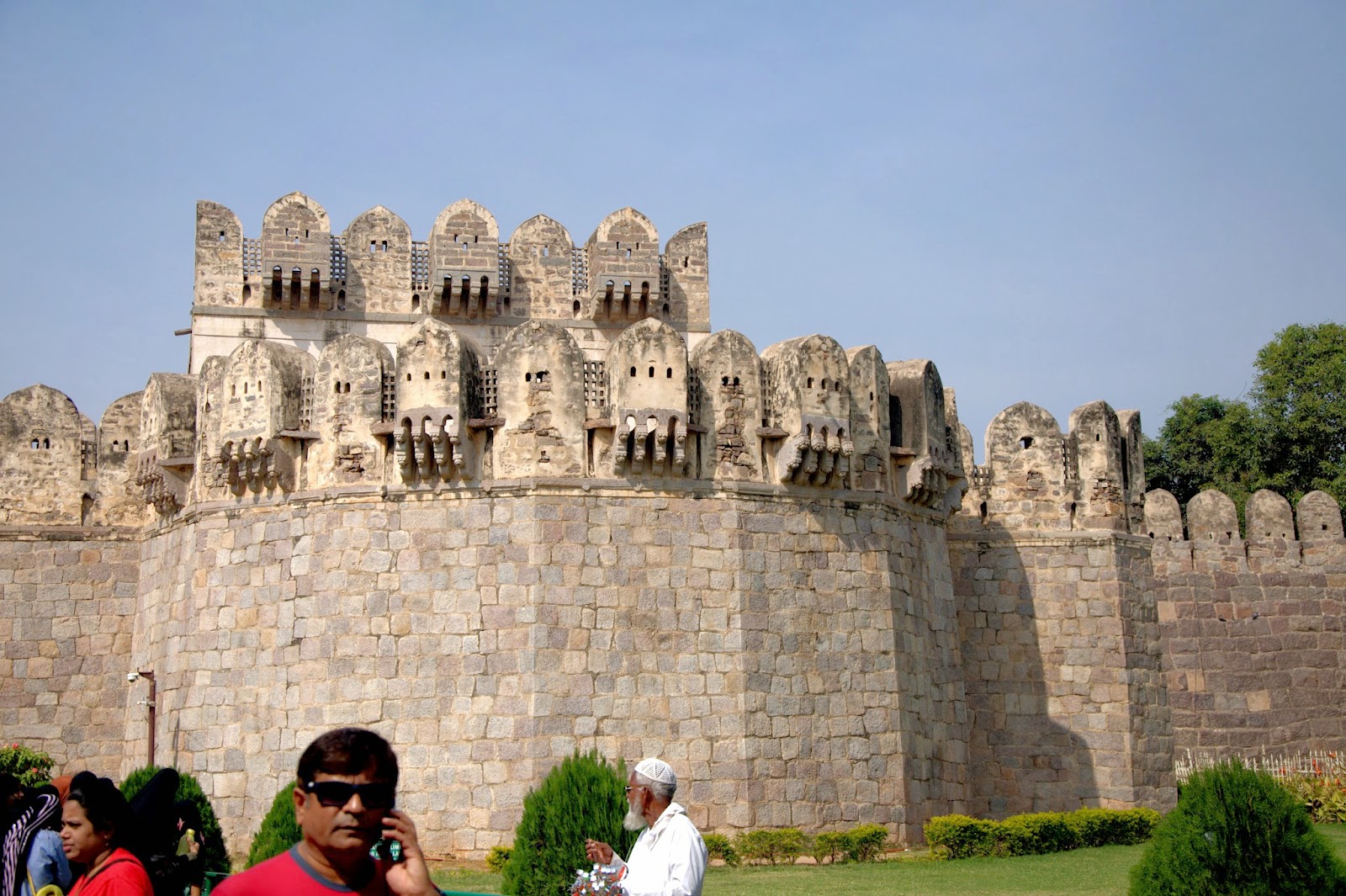
The Golconda fort at Hyderabad is an engineering marvel. One has to see it to believe it, how protected the fort was and how well it was equipped to carry messages in the form of rhythmic clapping to the other end of the fort.


The fort is built on a hillock, the natural boulders have not been been cut and the fort has been built along with them. It is fascinating to see huge boulders jutting out of the walls at some places. There are many water reservoirs, hidden mud pipelines and hammams (community washrooms) with water heating facilities and the sound acoustics in some parts of the fort is admirable.


While we would remember Hyderabad for the Qutub shahi monuments, the tomb complex of Qutub shahi rulers and the Golconda fort built by them, we have more reasons to remember this place thanks to my friend Bhavana who introduced me to Madhu Reddy, a farmer who is practicing her belief in chemical (synthetic chemicals) free framing at her ancestral farm at Yacharam village, 55 Kms from Hyderabad city. The farm is called Aiyor Bai.

There is a lot to learn from Madhu. Farming in an arid land is not easy, she makes her own manure by different natural techniques and uses drip irrigation for better water management. She encourages  shrubby legumes to grow below the orchard trees to enrich the soil as well as to add more organic matter to the soil. Her aim is develop a forest like microecology with mixed fruit orchard and farm that sustains itself like natural forests do. I wish more farmers follow this model to grow food for the masses and more people respect food grown ethically. I actually felt very much at home at the farm, if only I owned a piece of farm land somewhere.

We enjoyed a warm malted ragi drink that Madhu made for us and went out to see the farm. We loved that malted ragi drink, I had another helping in fact.

Here is Madhu showing us around, educating us as we harvest a few vegetables and fruits for our lunch. Yes, I cooked lunch at the farm, with minimal utensils available. My friend Bhavana helped in the kitchen, Arvind clicked pictures and we had a lovely time together. To cherish for a long time.


We harvested carrots, thinned down the clumps of carrots growing together and got some really nice baby carrots too. Some white and pink radishes, loads of papaya, loads of mixed salad greens and baby spinach was plucked to make a mixed greens salad. Found a few ripe tomatoes to be used for salads or curry. I wasn't sure by this time what we will cook, but baby carrots were destined to be caramelized for a warm salad I had already decided. Then I saw sweet potato vines and decided to add some sweet potatoes to the warm salad as well. Recipe of this salad will be shared later.


The bigger carrots were grated and mixed with some Pomegranate seeds and Orange segments to make a cold salad. Since there was nothing to make any dressing, I added a bit of salty residue of the Hing peda (a chooran goil by Patanjali) to this salad and it was so good the salad vanished quickly.

Lack of a dressing did not bother us and we created a mixed greens salad just with salt and lime juice. There was no pepper, no oil apart from refined oil (that I detest normally) but there was good quality pink rock salt and fresh limes and coriander greens growing at the farm. The mixed greens massaged lightly with pink salt and lime juice were really great. The mix of Endives, Lolla rossa, Butter crunch, green garlic shoots, baby spinach and a few coriander greens tasted so good together.

Madhu also got some fresh coconuts plucked, Arvind broke one and scooped out the coconut meat that we snacked upon. A coconut so freshly plucked was a first time experience.

We also harvested some fresh Toor (Arhar/Pigeon peas) legumes and decided to boil them for a warm snack. Madhu had some very nice native variety of black eyed peas at the farm. I cooked a chilli kind of curry with it with 3 varieties of tomatoes added to it. She had some red rice flour and Jowar (millet) flour and talked of a mooli paratha. I decided to make a mooli paratha with these 2 types of flours added (recipe below).


I am using approximate measurements as I just eyeballed everything for this paratha.


Recipe of the mooli paratha with jowar and red rice flour (gluten free)

ingredients
(for 10-12 parathas)

red rice (or white rice) flour 3 tbsp
jowar flour 1.5 cups or a bit more
grated fresh radish 2 cups packed
chopped green chillies 2 tsp or t taste
chopped coriander greens 1/4 cup
grated ginger 1 tbsp (I didn't use ginger at the farm as it was not there, but I normally add to my mooli paratha)
ajwain seeds 1 tsp (was not there at the farm but tastes great in mooli paratha)
salt to taste
ghee or oil to cook 1 tsp per paratha

procedure

Mix the rice flour with 1.5 cup of water and 1 tsp salt. Now cook this mixture till it becomes a gruel and bubbles and spews hot air as the bubbles burst. It should be a cake batter consistency.

Now mix the grated radish, other chopped ingredients and jowar flour and massage well together. Add the cooked rice gruel little by little to bind the dough. Some of the rice gruel may get leftover.

Make 10-12 balls of manageable size and keep aside. Roll each ball of dough, dusting it nicely to make round flat breads.

Heat a tawa (flat base pan), brush with oil, lift the rolled flat bread and slap it on the hot tawa, cook on both sides brushed with little oil till small brown spots appear and the paratha becomes firm. Repeat with all the rolled parathas (flat breads) and serve as required. Best served hot but we had it warm.

At the time of serving we decided to make burrito style rolls with the cooked black eyes peas and the mixed greens salad. This was a tasty filling meal that satisfies the soul.


We had already steeped some Roselle seeds in hot water and set it to cool to make a drink with it. Some basil seeds were soaked to top up the drink, a little honey was added to it and it made such a refreshing drink after a working day at the farm. I hope Madhu enjoyed as much as we did.


Later a lady farm-worker Eswar amma came to complement me about the food. She looked quite happy while doing so and I believe her complement was genuine, else I know the farm workers don't like the salads etc much.

Look at the lush growth of papaya trees at the farm.


We came back with more papayas to eat for breakfast the next day. The fruits of learning stay with us for long time.

We are already planning to go back to Aiyor Bai again sometime soon. Such is the way unspoiled nature attracts you.

 
Healthy Way powered by blogger.com
Design by Free7 Blogger Templates Simple Clean